1. What frequency ranges do your RF services cover?
We cover the spectrum from Low Frequency (LF) and High Frequency (HF) up to Millimeter Wave (mmWave) bands (24GHz to 77GHz+).
2. Can you assist with WiFi 6/6E and WiFi 7 transitions?
Yes. We have extensive experience with 4x4 MIMO configurations and the latest tri-band architectures using advanced SoCs.
3. How do you handle EMI/EMC issues in compact designs?
We utilize specialized shielding, component partitioning, and multi-layer PCB stackups to mitigate electromagnetic interference at the source.
4. Do you provide antenna design and tuning services?
We offer custom PCB antenna design, antenna selection, and impedance matching to ensure optimal radiation patterns and efficiency.
5. What tools do you use for RF simulation?
We utilize industry-standard EDA tools for schematic capture, layout, and 3D electromagnetic field simulation.
6. Can Qmax Systems help with 4G/5G private network hardware?
Yes, we design RF front-ends, including LNAs and Power Amplifiers, specifically for cellular infrastructure.
7. What is your experience with high-power RF?
We have successfully developed RF generators up to 1KW for industrial plasma applications, focusing on thermal management and power stability.
8. Do you support LoRa and other Long Range LPWAN protocols?
Yes, we have designed several LoRa-based devices for industrial and agricultural sensing.
9. How do you ensure ground loop elimination?
We implement star-grounding, split planes, and differential signaling where appropriate to prevent common-mode noise.
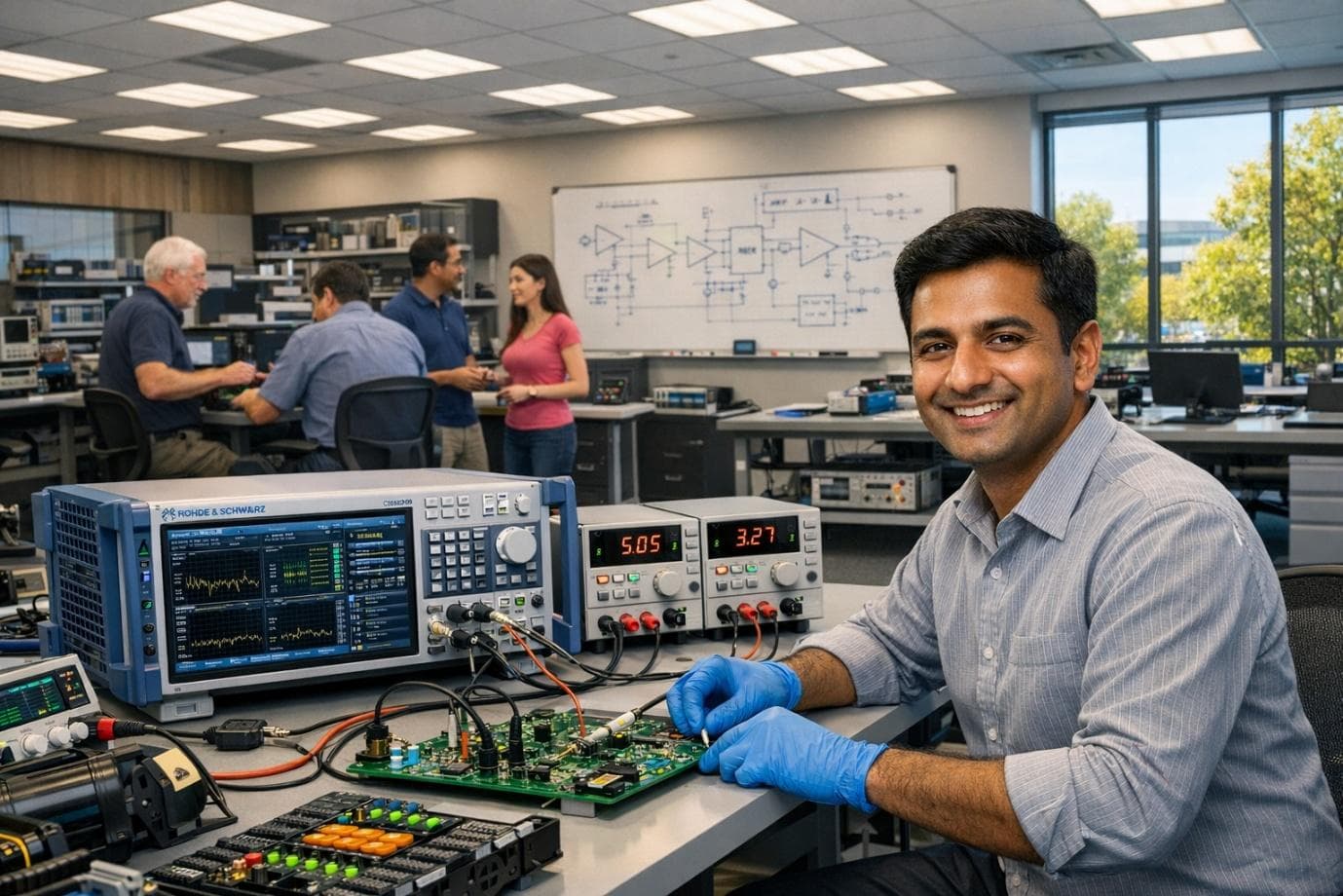
10. What in-house testing capabilities do you have?
Our lab is equipped with the R&S CMW500, spectrum analyzers, and high-speed oscilloscopes for comprehensive signal characterization.
11. Can you optimize a design for low power consumption?
Our work on BLE reference designs for semiconductor companies demonstrates our ability to maximize battery life through hardware and firmware optimization.
12. Do you handle mmWave sensor integration?
Yes, we have implemented several mmWave sensors for proximity and velocity detection in industrial environments.
13. What materials do you recommend for Microwave PCBs?
Depending on the frequency and loss budget, we typically specify Rogers, Taconic, or Panasonic Megtron series materials.
14. Can you help with FCC/CE certification?
While we are a design house, we perform extensive pre-compliance testing to help ensure your product passes official certification on the first attempt.
15. What information is needed to start an RF project?
Ideally, we require the link budget, required frequency bands, power output targets, and any mechanical constraints regarding PCB size or enclosure.
How does WiFi 7 improve throughput compared to WiFi 6?
WiFi 7 achieves speeds up to 46 Gbps by utilizing 320 MHz channels and 4096-QAM. WiFi 6 is limited to 160 MHz and 1024-QAM. WiFi 7 also introduces Multi-Link Operation (MLO), allowing devices to transmit data across 2.4, 5, and 6 GHz simultaneously to reduce latency and congestion.
What are the primary challenges in 5G mmWave PCB design?
High atmospheric attenuation and extreme sensitivity to trace geometry are the critical hurdles. At mmWave frequencies (24GHz+), even a 0.1mm deviation in trace width can cause impedance mismatches. We use low-loss substrates and 3D EM simulation to mitigate these parasitic effects.
How do you prevent desensitization (Desense) in multi-radio IoT devices?
We reduce Desense through high-rejection BAW filters and strategic spatial isolation. By partitioning the RF front-end and optimizing the PDN, we prevent harmonics from digital clocks or LTE transmitters from raising the noise floor of sensitive WiFi or GPS receivers.
Why is MU-MIMO essential for enterprise WiFi networks?
MU-MIMO allows an access point to communicate with multiple clients simultaneously rather than sequentially. In high-density environments, this reduces airtime fairness issues. We optimize antenna arrays for low Envelope Correlation Coefficient (ECC) to maintain distinct spatial streams.
What is the maximum range of a LoRaWAN link in an urban environment?
Typical urban range is 2-5 km, depending on link budget and building density. We optimize range by selecting high-gain antennas and tuning spreading factor to balance data rate against receiver sensitivity.
How do you protect a 1kW RF generator from high VSWR?
We implement high-speed directional couplers and foldback circuitry. When plasma loads become unmatched, reflected power can damage the PA. Our designs detect these shifts quickly and reduce output power until impedance is stabilized.
Why is 13.56 MHz a standard frequency for industrial plasma generators?
13.56 MHz is an assigned ISM band that offers a practical balance between ion energy and plasma density. It enables efficient power delivery while keeping interference manageable when the matching network is tuned for chamber impedance.
What is the best PCB substrate for high-power RF applications?
Rogers 4350B and Megtron 6 are common standards due to low dissipation factor (tan delta). Standard FR-4 absorbs more RF energy, causing dielectric heating and higher signal loss.
How do you manage thermal dissipation in GaN-on-SiC power amplifiers?
We use copper-filled thermal vias and embedded coins to pull heat directly from the die. GaN devices operate at high power density, so low-resistance thermal paths to a heatsink are essential for safe junction temperatures.
What is the role of a matching network in an RF system?
A matching network maximizes power transfer by aligning source and load impedance to 50 Ohm. Using Smith chart synthesis, we design LC or microstrip networks to reduce reflections and improve efficiency.
Why did my product fail FCC Part 15 Radiated Emissions?
Failures are often caused by unintended antennas such as unshielded cables or poorly bypassed traces. We use near-field probes to identify leakage and apply common-mode chokes or shielding to suppress offending harmonics.
What is the difference between pre-compliance and full certification?
Pre-compliance is an engineering phase used to find and fix issues early. Full certification is the final formal testing required for market access. We use pre-compliance to reduce risk before accredited testing.
How can I reduce Conducted Emissions (CE) in a switching power supply?
A tuned Pi-filter at the power input is typically effective. We also apply ground-loop control and snubbers on switching FETs to reduce high-frequency ringing that couples into power lines.
What are FCC requirements for modular approval vs full integration?
Modular approval can use a pre-certified radio, but products still require unintentional radiator testing. Full on-board radio integration requires stricter intentional radiator certification.
How do you shield sensitive analog signals from RF interference?
We use Faraday shielding, differential signaling, and internal stripline routing between ground planes to isolate sensitive traces from high-power RF fields.
What is controlled impedance and why is it critical for RF?
Controlled impedance maintains target line impedance, typically 50 Ohm, to reduce reflections. Changes in trace geometry or stubs cause VSWR spikes, lower signal quality, and potential component stress.
How does skin effect impact RF PCB layout?
At higher frequencies, current crowding near the copper surface increases effective resistance. We address this with suitable trace geometry and surface finish choices to reduce loss.
What is the fiber weave effect in high-speed RF boards?
Fiber weave can create differential timing skew because one trace may travel over resin while the other travels over glass. We mitigate this using routing strategies and spread-weave materials.
Why should I avoid via stubs in high-frequency designs?
Via stubs can behave as resonant discontinuities and reflect energy. For high-frequency channels, we specify back-drilling or blind/buried vias to remove unused stub length.
How do you calculate the link budget for a wireless product?
Link budget equals transmit power plus antenna gain minus path loss minus fade margin. We use this to estimate real-world range and verify receiver sensitivity margins.
What is a VNA (Vector Network Analyzer) used for?
A VNA measures S-parameters for impedance match and transmission behavior. It quantifies how much power is reflected (S11) versus transmitted (S21).
What is EVM (Error Vector Magnitude) and why does it matter for WiFi?
EVM is a metric of modulation quality. Higher EVM indicates noisier constellation points, which can force lower modulation schemes and reduce throughput.
How do you perform RF near-field vs far-field testing?
Near-field probing helps identify local PCB noise sources. Far-field testing, typically in an anechoic environment, measures actual radiation behavior and patterns.
Can you simulate an antenna's performance before building the PCB?
Yes. We use 3D EM simulation to model gain, bandwidth, matching, and radiation patterns before physical prototyping.
What is TRP (Total Radiated Power) in mobile device testing?
TRP measures total emitted antenna power across all directions. It captures both antenna efficiency and enclosure effects that are not visible in simple conducted cable tests.
What is the typical cost of an RF design re-spin?
A re-spin can cost thousands to tens of thousands of dollars in fabrication and testing, plus schedule delay. We prioritize simulation and pre-compliance to reduce this risk.
How do you ensure unit-to-unit consistency in mass production?
We specify controlled-impedance coupons per panel and use production test strategies to verify RF behavior, helping ensure repeatability from pilot builds to volume manufacturing.
Does Qmax help with component sourcing and BOM optimization?
Yes. We balance performance, cost, and lifecycle availability, and proactively identify second-source options for critical components.
What is phase noise and how does it impact high-speed data?
Phase noise is frequency-domain instability in oscillators. For high-order modulation schemes, excess phase noise degrades demodulation margin and data integrity.
How do you approach RF design for medical vs military applications?
Medical designs emphasize coexistence and patient safety, while military designs emphasize robustness and interference resilience. We adapt design and validation strategy to target standards and use environments.