High-Speed Digital PCB Design - Qmax Systems
PCB DESIGN SERVICES

Advanced High-SpeedDigital PCB Engineering.

In an era defined by 112G SerDes, DDR5 memory architectures, and PCIe Gen6 protocols, PCB design is no longer just about connectivity - it is about physics. Qmax Systems provides specialized high-speed digital PCB design services that bridge the gap between complex architectural requirements and reliable, production-ready hardware.

Our engineering-first approach prioritizes Signal Integrity (SI) and Power Integrity (PI) simulation long before a single trace is routed. By implementing a simulation-driven constraint methodology, we ensure your high-complexity boards - from AI GPU chassis to O-RAN Distributed Units - achieve first-time-right success.

Applications & Real-World Project Experience

Qmax Systems delivers field-proven expertise in developing mission-critical hardware. Our portfolio includes:

O-RAN Distributed Units (DU)

Developed using Ampere Altra processors. These designs involve massive pin-count BGA escape routing, complex power delivery networks (PDN) to support high TDP, and synchronized timing for 5G radio units.
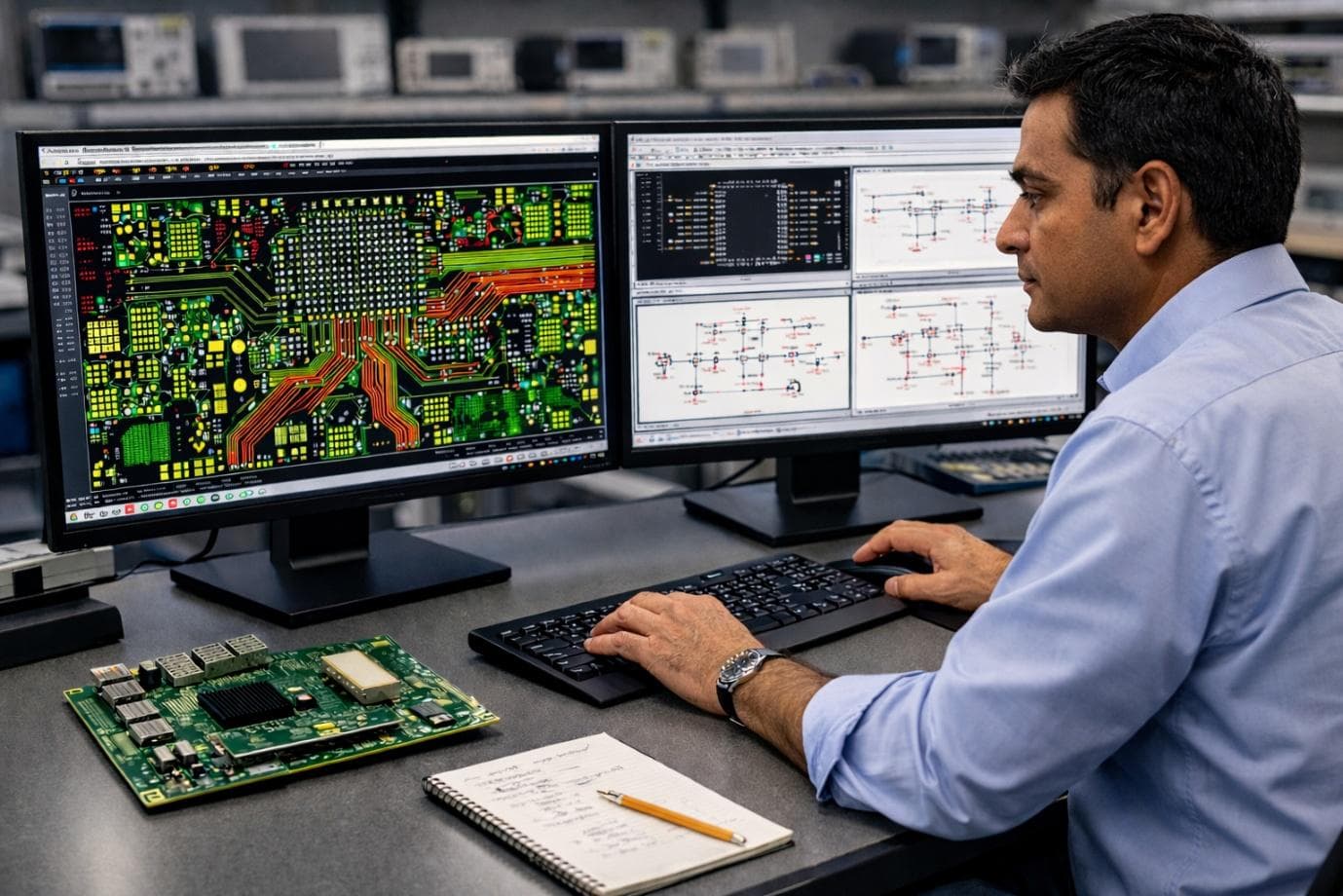
AI GPU Chassis PCIe Gen6 Switch Boards

Engineering of ultra-high-bandwidth fabrics requiring precision routing for 64 GT/s signaling, stringent insertion loss budgets, and advanced material selection to mitigate fiber weave effects.

Server Motherboards (Intel Sapphire Rapids / AMD EPYC)

Comprehensive layout for multi-socket architectures, including DDR5-6400+ 8-channel memory routing and high-density interconnect (HDI) transitions.

100G x 4 Network Interface Cards (NIC)

Designed for blade server environments utilizing QSFP-DD form factors and 25G/56G NRZ/PAM4 SerDes lanes.

FPGA-Based Image Processing

High-speed LVDS and MIPI CSI-2 interfacing for real-time 8K video capture, focusing on precise phase matching and skew control.

NXP i.MX8 Single Board Computers (SBC)

Compact, multi-layer designs balancing thermal management with high-speed LPDDR4x routing in space-constrained industrial envelopes.

Core Switches & Routers

High-layer count backplanes (30+ layers) with complex E-T-P (Equalization, Termination, and Propagation) parameters.

Technical Capabilities: Pushing the Limits of Physics

Our design team operates at the leading edge of digital signaling standards:

Memory & High-Speed Interfaces

DDR5 & LPDDR5

Implementation of Decision Feedback Equalization (DFE), CA parity, and CRC. We manage ultra-tight timing margins and address the complexities of on-DIMM PMICs.

PCIe Gen5 & Gen6

Expertise in PAM4 signaling, ensuring compliance with strict jitter and noise floor requirements.

112G SerDes

Advanced routing for 112 Gbps per lane, utilizing state-of-the-art simulation to minimize reflections and crosstalk.

Advanced HDI & Fabrication Support

30-Layer HDI PCB Design

Mastery of Type I, II, and III HDI structures, including stacked and staggered microvias, via-in-pad, and ELIC (Every Layer Interconnect).

USB4 & Thunderbolt 4

High-speed differential pair routing with integrated ESD protection and EMI containment.

Stackup Engineering & Material Selection

A robust high-speed design begins with the substrate. We perform rigorous stackup optimization to balance electrical performance with fabrication yield.

Material Expertise

Selection of ultra-low-loss laminates such as Megtron 6/7/8, Tachyon 100G, and Rogers hybrids.

Impedance Control

Precision modeling of single-ended (50 Ohm) and differential (85 Ohm/90 Ohm/100 Ohm) traces.

Glass Weave Mitigation

Use of "spread glass" fabrics and zig-zag routing techniques to eliminate skew.

SI/PI/EMI Simulation Methodology

We do not "guess and check." Our workflow is simulation-driven:

Pre-Layout Analysis

Determining stackup, material, and topology constraints.

Post-Layout Verification

Full-wave extraction of routing to verify Eye Diagrams, BER (Bit Error Rate), and TDR (Time Domain Reflectometry).

Power Integrity (PI)

Analyzing DC IR Drop, AC impedance profiles, and decoupling capacitor optimization to support high-transient current demands.

EMI/EMC

Identifying potential radiation hotspots and resonance issues before the prototype stage.

Complimentary Schematic Review

High-speed PCB success starts at the schematic level. Every Qmax PCB layout engagement includes a Complimentary Schematic Review. Our senior engineers analyze your design for:

  • Pin-mapping optimization for routing efficiency.
  • BOM risk mitigation and component obsolescence checks.
  • Power tree verification and decoupling strategies.
  • Compliance readiness for CE, FCC, and UL certification.

Why Choose Qmax Systems?

FeatureQmax Engineering Advantage
PhilosophyArchitecture-first; Simulation-driven constraints.
IP Ownership100% Customer Ownership of all design files.
ManufacturingDirect coordination with Tier-1 fabrication and assembly houses.
ComplianceDesign for EMI/EMC (CISPR 32) and Safety (UL 62368-1).
ReliabilityProduction-ready DFM/DFT (Design for Manufacturing/Test).

Industries Served

Data Centers

AI servers, GPU accelerators, and high-speed networking.

Telecommunications

5G O-RAN, Edge computing, and SatCom.

Aerospace & Defense

High-reliability FPGA processing and ruggedized SBCs.

Automotive

ADAS sensors and infotainment backbones.

Accelerate Your Hardware Development

Don't let signal integrity issues delay your product launch. Partner with an engineering team that understands the complexities of modern high-speed digital design.

1-Hour Complimentary Engineering Consultation

Struggling with a PCIe Gen6 loss budget? Unsure about your DDR5 stackup? Speak directly with a senior Qmax hardware architect. No marketing, just engineering.
Frequently asked questions.

What is your approach to DDR5 PCB layout?
We use simulation to define length matching, T-topology or fly-by constraints, and verify signal eye opening against JEDEC standards.
Do you support PCIe Gen6 PCB layout?
Yes, we are experts in PCIe Gen6 layout, specifically managing the transition to PAM4 signaling and tight loss budgets.
Can you handle 30-layer HDI PCB designs?
Absolutely. We regularly design 30+ layer boards with complex microvia structures and ELIC.
Do you provide SI/PI simulation services separately?
Yes, we offer standalone SI/PI analysis or integrated simulation within the layout process.
How do you mitigate crosstalk in high-density designs?
Through rigorous 3D EM modeling and implementing specific 3W/5W spacing rules and guard traces.
Which EDA tools do you use?
We primarily utilize Cadence Allegro/Orcad, Altium Designer, and Mentor Xpedition.
What is a "Simulation-driven" constraint?
It means we run SI simulations to determine the exact routing rules (width, gap, length) before the layout starts.
Do you provide DFM reports?
Yes, every design undergoes a comprehensive DFM/DFT check to ensure high manufacturing yields.
Can you help with component obsolescence?
Yes, during schematic review, we identify at-risk parts and suggest pin-compatible or functional alternatives.
What is your experience with 112G SerDes?
We have designed interfaces for 112G PAM4, focusing on via stub removal (back-drilling) and pad stack optimization.
Do you support 100G Ethernet NIC design?
Yes, we have experience with multi-port 100G NICs and QSFP-DD/OSFP form factors.
What materials do you recommend for high-speed digital PCBs?
Typically Megtron 6/7, Isola I-Tera, or Rogers 4350B/4003C depending on the frequency and budget.
How do you handle high-current PDNs?
We use PI simulation to map DC IR drop and ensure copper density is sufficient for thermal and electrical requirements.
Is Qmax an Indian PCB design company?
Yes, Qmax Systems is a leading high-speed digital PCB design services provider in India, serving global clients.
Do you design server motherboards?
Yes, we design multi-processor server motherboards for Intel, AMD, and ARM architectures.
What is your first-time-right ratio?
Over 95% of our high-speed designs move to production without requiring a second spin for electrical issues.
Can you design for O-RAN hardware?
Yes, we have specific experience with O-RAN Radio Units (RU) and Distributed Units (DU).
Do you manage the fabrication process?
We coordinate directly with your preferred fab house or recommend one from our audited partner list.
What is back-drilling, and when is it used?
It is the removal of unused via stubs to prevent signal reflections, critical for signals above 10Gbps.
Do you support USB4 design?
Yes, including routing for 40Gbps throughput and Type-C PD integration.
How do you minimize EMI?
Through proper ground plane referencing, shielding, and minimizing common-mode noise via balanced routing.
What is ELIC?
Every Layer Interconnect-an HDI technology where any layer can be connected to any other layer using stacked copper-filled microvias.
Do you provide the source files?
Yes, all design IP, including source schematics, layout files, and simulation models, belongs to the customer.
How do you handle differential pair skew?
We implement serpentine trace compensation and phase-matching at the point of mismatch.
Can you design AI GPU chassis PCBs?
Yes, we specialize in the high-speed backplanes and switch boards required for AI clusters.
What is a PDN impedance profile?
It is a plot of the power network's impedance vs. frequency, ensuring it stays below the target impedance to prevent noise.
Do you support NXP i.MX8 designs?
Yes, we have extensive experience with the i.MX8 family and its LPDDR4 memory requirements.
What are fiber weave effects?
Variations in the dielectric constant caused by the resin/glass pattern. We mitigate this with angled routing or specific glass styles.
Do you offer thermal simulation?
Yes, we can perform thermal analysis to identify hotspots and optimize heatsink/fan placement.
How do I get started?
You can book a 1-hour complimentary engineering consultation via our website.