RF and Microwave PCB Design - Qmax Systems
PCB DESIGN SERVICES

RF and MicrowavePCB Design Services.

High-Frequency RF Layout | Microwave PCB Engineering | mmWave Design up to 80 GHz

Modern RF and microwave systems demand far more than conventional PCB routing. At frequencies from hundreds of MHz to millimeter-wave bands, the PCB becomes part of the RF circuit itself. Trace geometry, dielectric loss, via transitions, grounding topology, shielding strategy, and impedance discontinuities directly influence insertion loss, phase stability, noise floor, and EMI compliance.

Qmax Systems provides advanced RF PCB design services for wireless communication systems, RF instrumentation, radar sensors, industrial RF generators, and microwave measurement platforms.

Our RF and microwave PCB design services include:

We work closely with fabrication partners using Rogers, Taconic, Isola, Megtron and hybrid stackups to achieve controlled impedance, low loss, and repeatable manufacturing yields.

RF PCB Engineering Approach

RF PCB layout is fundamentally an electromagnetic design problem.

At frequencies above a few hundred MHz, traditional digital PCB practices become insufficient because:

  • Transmission lines replace simple copper traces
  • Return current paths must be precisely controlled
  • Ground reference discontinuities introduce radiation
  • Substrate dielectric properties influence RF behavior

At Qmax Systems, we apply a structured RF engineering workflow:

  • Architecture Analysis
  • Stackup Engineering
  • Transmission Line Modeling
  • Constraint-Driven Layout
  • EM Simulation
  • EMI-Ready Layout Strategy
  • Manufacturing Alignment

This workflow ensures the design is production-ready and compliance-ready before the PCB is fabricated.

Applications & Real Project Experience

Qmax Systems has designed multiple RF and microwave PCBs across industrial, wireless, and sensing platforms.

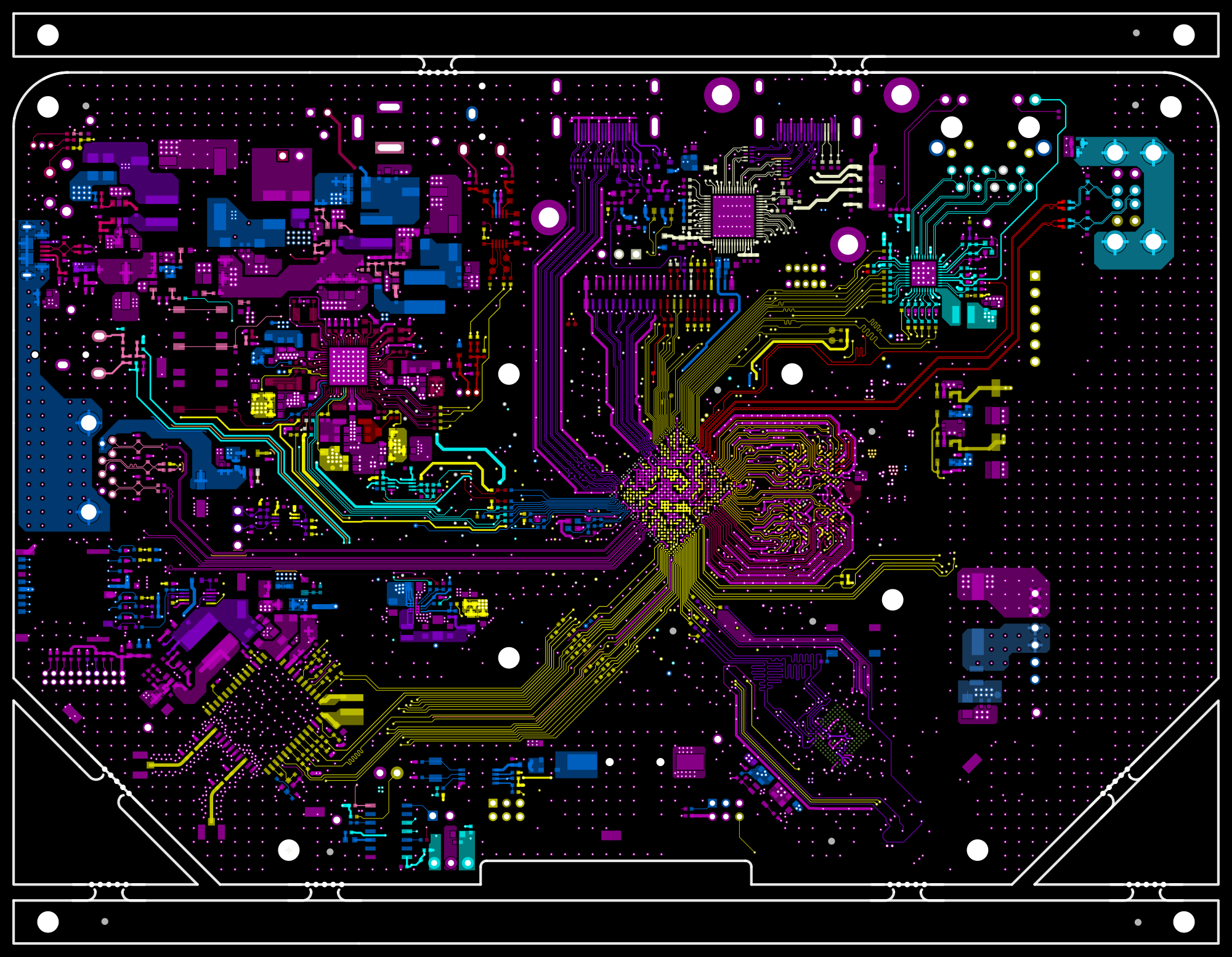
High-Power RF Power Amplifier - 1 kW @ 13.56 MHz

Industrial plasma generators and RF heating systems operate at high power levels where PCB parasitics become critical.

Technical design considerations:

  • High-current RF paths using wide copper geometries
  • Thermal spreading copper planes
  • Controlled RF current loops
  • High-voltage isolation for power stages
  • RF shielding between driver and output stage

Stackup considerations:

ParameterDesign Approach
Copper thickness2-4 oz copper
SubstrateLow loss RF laminate
Ground strategyContinuous RF ground plane
EMI controlShielding walls and cavity isolation

EMI mitigation is essential since high-power RF stages easily generate harmonics and conducted emissions.

See Case study
WiFi-6 MIMO RF PCB Design

2.4 GHz 4x4 | 5.1 GHz 4x4 | 5.8 GHz 4x4

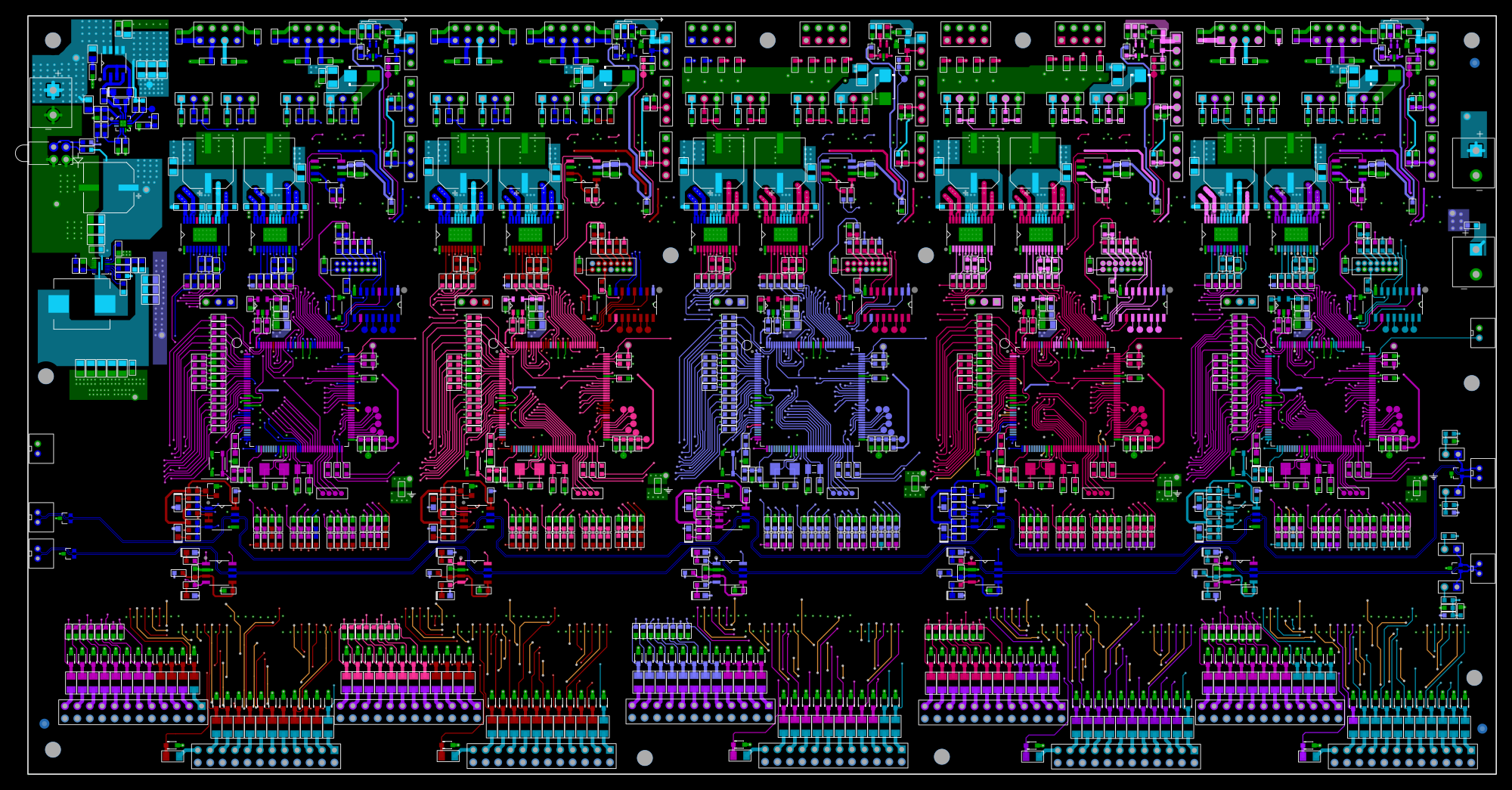
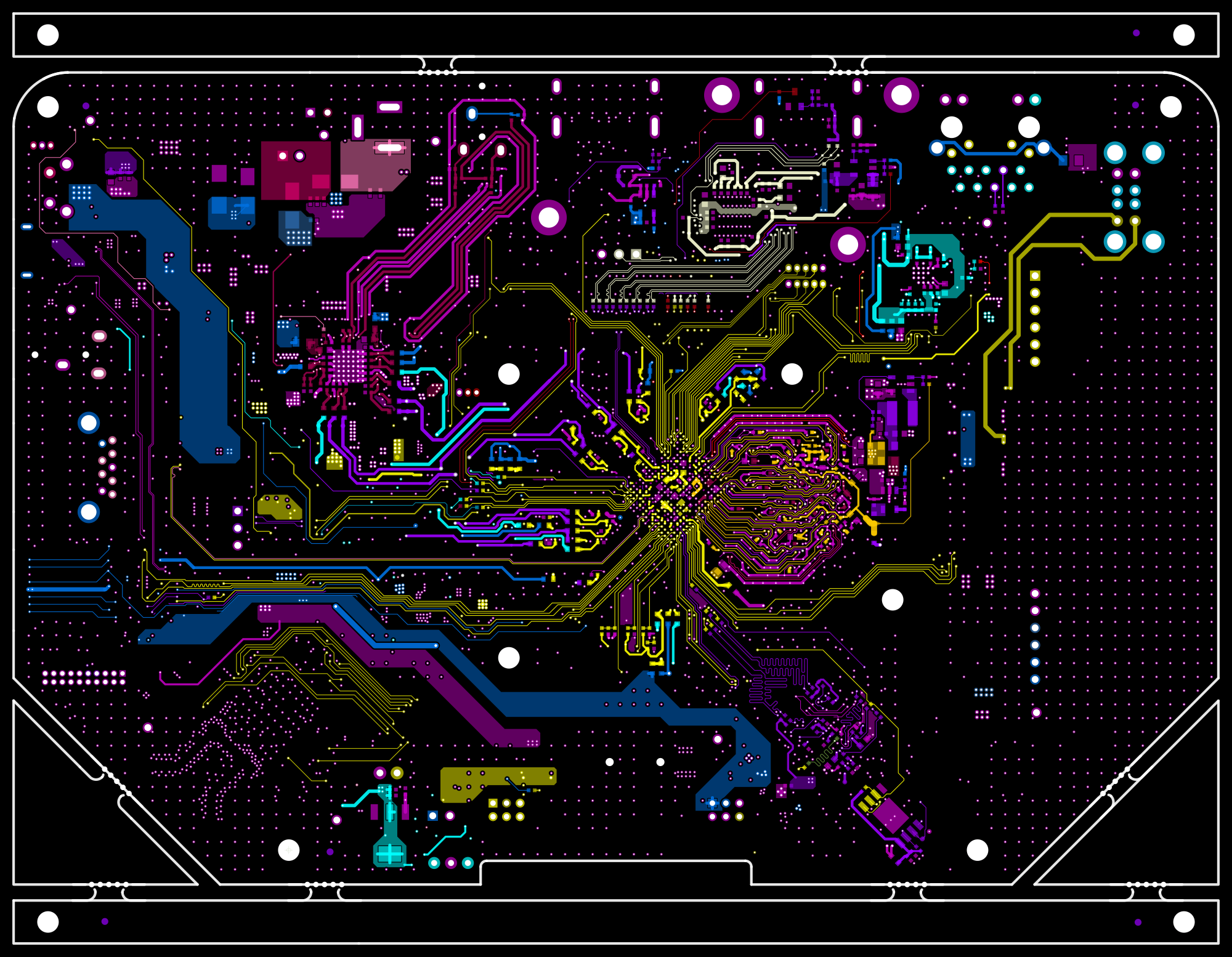
We have designed complex WiFi-6 RF boards integrating multiple RF chains including:

  • RF transceiver ICs
  • Power amplifiers
  • LNAs
  • RF filters
  • Antenna matching networks

Key RF PCB engineering considerations:

  • Equal RF path lengths across MIMO channels
  • Isolation between RF chains
  • Controlled impedance transmission lines
  • RF ground via fences
  • Antenna feedline optimization

Signal Integrity analysis was used to ensure:

  • RF trace impedance accuracy
  • Crosstalk suppression
  • RF noise isolation from digital sections

RF testing was validated using equipment such as:

  • Rohde & Schwarz CMW500
  • Spectrum analyzers
  • Vector network analyzers
See Case study

Software Defined Radio (SDR) RF Platforms

Qmax has developed RF PCBs for SDR architectures integrating:

  • RF front-ends
  • RF preamplifiers
  • RF power amplifiers
  • ADC/DAC converters

Critical layout constraints include:

  • Isolation between RF and digital sections
  • Phase-stable clock routing
  • Differential RF paths
  • Shielded RF modules

Typical stackup:

LayerFunction
L1RF components
L2RF ground
L3Digital signals
L4Power planes

This structure ensures clean RF return paths and reduced coupling noise.

See Case study

60 GHz Microwave Moisture Measurement System

Millimeter-wave designs require extremely careful PCB engineering due to:

  • Very short wavelengths
  • Higher dielectric losses
  • Strong sensitivity to layout parasitics

Technical architecture:

  • 60 GHz radar transceiver
  • IQ signal processing chain
  • RF mixers and LNAs
  • Microwave antenna feed structures

Design techniques used:

  • Microstrip and coplanar waveguide transmission lines
  • Via fence shielding
  • Sub-mil trace tolerance
  • Low-loss RF substrates
See Case study - need NDA

LoRa, WiFi, BLE Wireless Modules

We have developed several wireless communication PCBs integrating:

  • LoRa radios
  • BLE transceivers
  • WiFi modules
  • Antenna matching networks

Key design constraints include:

  • RF ground continuity
  • Antenna tuning networks
  • RF isolation from switching regulators
  • FCC pre-compliance considerations
See Case study

Technical RF PCB Capabilities

Qmax Systems supports RF PCB layout across a wide frequency spectrum.

Wireless Technologies

  • LTE RF boards
  • WiFi 5 / WiFi 6 / WiFi 7 PCB design
  • LoRa RF modules
  • BLE RF hardware
  • SDR RF platforms
  • RF front-ends

Frequency Coverage

  • Sub-GHz
  • 2.4 GHz ISM
  • 5 GHz WiFi bands
  • Microwave 24-60 GHz
  • mmWave sensor boards

RF PCB Layout Techniques

  • Microstrip transmission lines
  • Coplanar waveguides
  • RF via fences
  • Shielded RF compartments
  • RF impedance matching networks
  • Antenna feed optimization

RF Stackup Engineering & Material Selection

RF PCB material selection is critical to maintain signal integrity at microwave frequencies.

Common RF substrates used:

Stackup design parameters include:

ParameterImportance
Dielectric constant (Dk)Determines impedance
Loss tangent (Df)Affects insertion loss
Copper roughnessInfluences RF attenuation
Layer symmetryReduces warpage

Hybrid stackups combining RF materials with FR-4 layers are often used to control cost while preserving RF performance.

View Stackup Options

Complimentary Schematic Review

When customers engage Qmax Systems for RF PCB layout services, we perform a complimentary schematic review before layout begins.

The review covers:

  • RF signal chain architecture
  • Impedance matching networks
  • Power supply filtering
  • RF ground references
  • Component lifecycle risk

This early validation prevents costly PCB re-spins and RF tuning delays.

Contact Us

Why Choose Qmax Systems for RF PCB Design

FeatureQmax Advantage
Architecture-First EngineeringRF architecture validated before layout
Simulation-Driven ConstraintsRF constraints defined before routing
RF Measurement ExpertiseFamiliar with RF test equipment workflows
Manufacturing AlignmentDirect coordination with PCB fabrication houses
Compliance ReadinessDesigns prepared for FCC / CE certification
Production-Ready DeliverablesDFM / DFT validated files

Additional commitments:

  • Customer retains full design IP
  • Component obsolescence risk analysis
  • Manufacturing coordination

RF PCB Case Studies

Detailed RF engineering case studies are available demonstrating:

View RF PCB Case Studies

Industries Served

Qmax RF PCB design services support multiple industries:

  • Wireless communication
  • Industrial RF generators
  • Telecom infrastructure
  • IoT hardware
  • Radar sensors
  • RF test equipment
  • Defense electronics

Start Your RF PCB Development Project

If you are developing:

  • WiFi 6 / WiFi 7 hardware
  • RF power amplifiers
  • RF generators for Plasma Applications
  • Microwave sensing systems
  • SDR platforms
  • mmWave radar devices

Qmax Systems can support your project from RF architecture through production-ready PCB design. Contact us to discuss your requirements.

1-Hour Complimentary Engineering Consultation

We offer a free 1-hour technical consultation with our RF PCB engineers.

During this session we will review:

  • RF architecture risks
  • Stackup strategy
  • EMI compliance challenges
  • Manufacturing feasibility

Frequently asked questions.

1. What frequency range do you support?
We design RF PCBs from sub-GHz to millimeter-wave frequencies up to 80 GHz.
2. Do you design microwave PCBs?
Yes. We support microwave PCB designs using low-loss laminates and transmission line modeling.
3. Do you design WiFi RF boards?
Yes. We have designed WiFi 5 and WiFi 6 RF PCBs with multiple MIMO chains.
4. Do you support antenna integration?
Yes. We design antenna feedlines, matching networks, and RF isolation structures.
5. Do you perform RF simulations?
Yes. SI, PI, and EM simulations are performed before layout completion.
6. Do you support mmWave PCB designs?
Yes. We have experience with 60 GHz radar-based sensing systems.
7. What materials are used for RF PCBs?
Common materials include Rogers, Taconic, Isola Astra, and hybrid RF-FR4 stackups.
8. Do you coordinate with PCB fabrication houses?
Yes. Stackups and impedance targets are aligned with the chosen manufacturer.
9. Can you redesign RF boards that failed FCC testing?
Yes. We provide RF layout troubleshooting and redesign services.
10. Do you support RF power amplifier boards?
Yes. We have designed 1 kW RF PA systems.
11. Can you design LoRa RF boards?
Yes. LoRa transceiver boards with antenna tuning networks are supported.
12. Do you support BLE RF designs?
Yes. BLE modules with RF filtering and antenna matching are designed.
13. Do you support SDR hardware?
Yes. SDR RF front-ends and RF amplifier chains.
14. Can you design RF front-end modules?
Yes. Including LNAs, mixers, filters, and PAs.
15. Do you provide RF tuning support?
Yes. We support RF bring-up and calibration.
16. What tools are used for RF simulation?
HFSS, HyperLynx, and other EM modeling tools.
17. Can you design RF filters on PCB?
Yes. Microstrip and distributed RF filters.
18. Do you provide DFM review?
Yes. All designs undergo DFM validation.
19. Do you support mmWave antenna feeds?
Yes. Controlled impedance CPW and microstrip lines.
20. Can you design RF test equipment PCBs?
Yes.
21. What deliverables do you provide?
Gerbers, ODB++, impedance reports, and assembly documentation.
22. Do you handle RF shielding design?
Yes. Shield cans and RF compartments.
23. Do you design high-power RF boards?
Yes.
24. What RF test equipment are you familiar with?
CMW500, spectrum analyzers, vector network analyzers.
25. Do you design microwave sensors?
Yes.
26. Do you support FCC compliance preparation?
Yes.
27. Do you support CE compliance preparation?
Yes.
28. Who owns the design IP?
The customer owns all design IP.
29. Do you support prototype bring-up?
Yes.
30. Can you support production transfer?
Yes.