Advanced Modular Medical Simulator — Developer Kit
Project Overview
A Minneapolis, MN-based medical simulation company engaged Qmax Systems to design and develop the complete embedded electronics platform for an Advanced Modular Medical Simulator Developer Kit (AMMDK) — the central computing, networking, and power backbone of a next-generation open-standard, interoperable medical training manikin. Qmax delivered the full hardware platform — architecture, PCB design, firmware, Linux/RTOS bring-up, peripheral driver APIs, EVT, DVT, and small-volume production — enabling any third-party developer to build AMM-compatible simulation modules.
Product Brief
The AMMDK is a multi-board embedded electronics platform built around the Qualcomm Snapdragon 820 System-on-Module (SoM) as the main application processor, a dedicated 9-port Broadcom BCM53128 Gigabit Ethernet switch board as the module network backbone, and a very high-power PoE Sourcing Equipment stage that delivers both data and actuation power to each manikin segment over a single Ethernet cable. The Snapdragon SoM runs Linux; an NXP Kinetis K66 ARM Cortex-M4F runs an RTOS for hard real-time peripheral I/O, with a K20 for non-intrusive debug. The platform exposes GbE, USB 3.0, HDMI, CAN, SPI, I²C, UART, GPIO, ADC, DAC, and PWM through a main board and an interchangeable Application Board. Qmax developed the entire hardware platform, the Linux BSP, the RTOS layer, and the full peripheral driver API and test suite; the application software was built by the customer and third parties on the open-source AMM standards.
Qmax Scope of Work
The customer provided the overall system architecture concept and program requirements. Qmax Systems executed the complete hardware platform development — through EVT, DVT, and small-volume production. Qmax did not develop the end-application software; Qmax delivered the hardware, firmware, OS bring-up, and all peripheral driver APIs on which the application layer was built:
- Hardware Architecture — full system architecture refinement and multi-board schematic design covering the Qualcomm Snapdragon 820 SoM, the 9-port Broadcom BCM53128 Gigabit Ethernet switch board, the high-power PoE PSE stage, Kinetis K66 / K20 MCUs, USB 3.0 hub, CAN transceiver, level translators, and all peripheral I/O
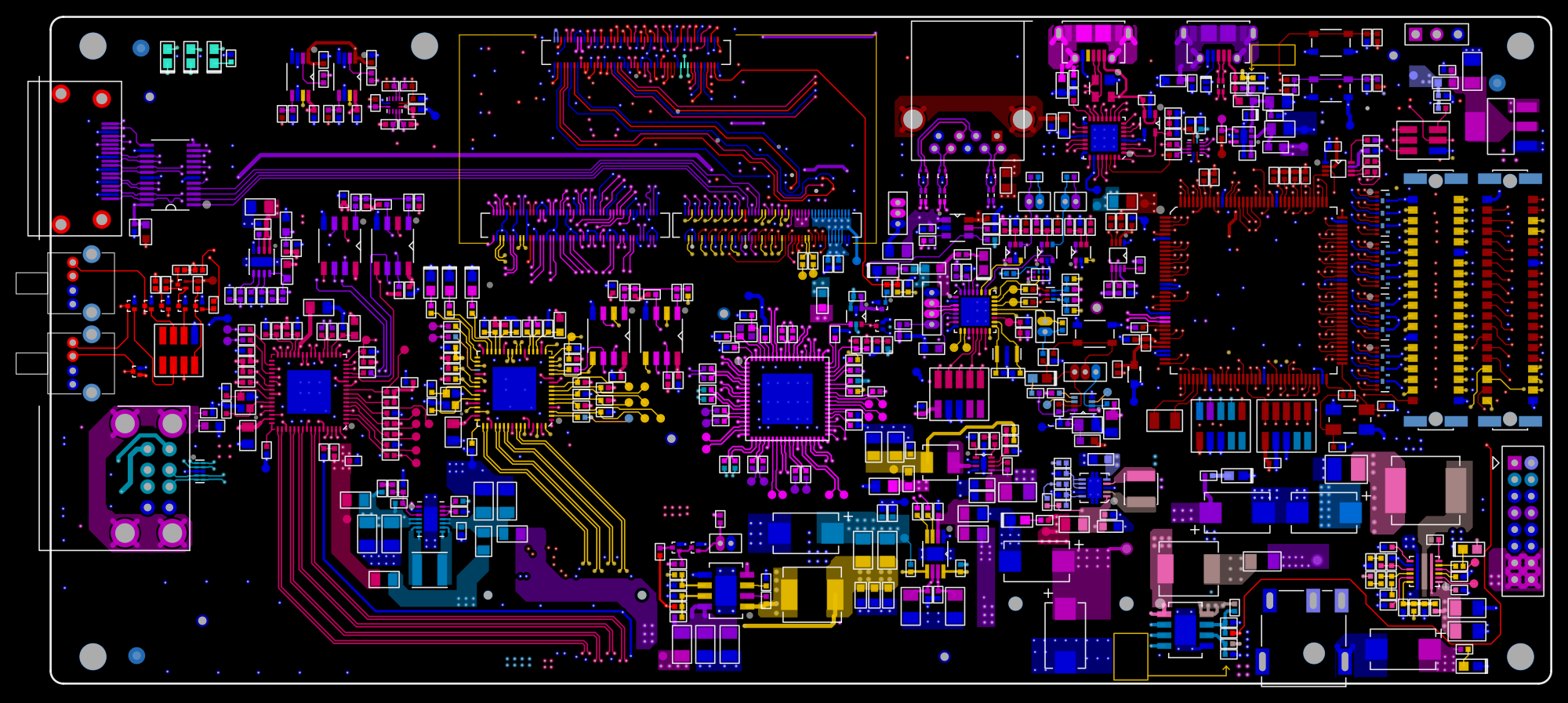
- PCB Design — multi-layer impedance-controlled PCB layout for the AMMDK main board, the 9-port Gigabit Ethernet switch board, and the Application Board; high-speed routing for 8× GbE channels, USB 3.0, PCIe, HDMI, and DDR; power-domain isolation between the high-power PoE / 48V actuator bus and 3.3V / 1.8V logic
- 9-Port Gigabit Ethernet Switch Board — dedicated network switch board built on the Broadcom BCM53128 — one uplink port to the Qualcomm SoM and eight downstream PoE-injected ports feeding distributed manikin module segments; full MDIO switch management and VLAN/QoS channel isolation
- High-Power PoE PSE Design — very high-power Power-over-Ethernet Sourcing Equipment stage delivering both Gigabit data and high-current actuation power to each manikin segment over a single Ethernet cable, with per-port power negotiation, budgeting, and fault protection
- Firmware & RTOS — U-Boot bootloader and Linux BSP/device tree on the Snapdragon 820 SoM; RTOS-based real-time firmware on the Kinetis K66 for all peripheral I/O (CAN, SPI, I²C, UART, GPIO, ADC, DAC, PWM); K20 debug firmware; switch and PoE management firmware
- Peripheral Driver APIs — complete, documented peripheral driver API layer for every interface — GbE switch, PoE control, CAN, USB, SPI, I²C, UART, GPIO, ADC, DAC, PWM, HDMI — enabling the customer and third-party module developers to build application software without low-level embedded effort
- Peripheral Testing & Validation — bring-up and exhaustive functional testing of every peripheral and interface — all 8 switch ports, PoE delivery per port, CAN, USB 3.0, HDMI, analog ADC/DAC channels, and all serial buses — with documented test results and test firmware
- EVT (Engineering Validation Test) — engineering validation builds, design verification of all subsystems, and resolution of hardware bring-up issues prior to design freeze
- DVT (Design Validation Test) — formal design validation through multi-contractor system integration events (Mule 1, May 2018; Mule 2, October 2018) — full integration with fluidics, physiology engine, chest-rise module, and peripheral modules
- Small-Volume Production — small-volume manufacturing of the AMMDK main board, the 9-port switch board, and Application Boards for prototype manikin builds, validation studies, and external module developer kits; all hardware/firmware released open-source under Creative Commons 4.0
Engineering Challenges
9-port Gigabit switch with per-port PoE
Designing a single switch board around the Broadcom BCM53128 that combines eight downstream Gigabit data ports — each carrying high-power PoE injection — plus one uplink to the Qualcomm SoM, while maintaining signal integrity on all channels and keeping the high-current PoE planes isolated from the GbE pairs
Very high-power PoE budgeting across segments
Delivering high-current actuation power to multiple manikin segments simultaneously over Ethernet required careful per-port power negotiation, total-budget management, magnetics selection, and thermal design so distributed actuators could run concurrently without exceeding the PSE budget
Multi-processor Linux + RTOS architecture
Running a Linux application stack on the Snapdragon 820 SoM for high-level networking and simulation management alongside a hard real-time RTOS loop on the Kinetis K66 for deterministic actuator and sensor timing — bridging the two domains over USB while preserving sub-millisecond real-time response
High-power actuator bus alongside sensitive logic
The 48V high-current actuator/PoE bus had to be fully isolated from 3.3V / 1.8V digital logic; galvanic isolation, high-side power MOSFET drive, ground-plane splits, and layered protection were required on densely populated boards
High-density multi-protocol PCB layout
Routing eight Gigabit Ethernet channels, USB 3.0, HDMI, PCIe, CAN, SPI, I²C, UART, ADC, DAC, and PWM across the main board and switch board — with correct impedance control, differential-pair matching, and power-plane partitioning around the SoM, switch IC, and two MCUs
Gigabit switch management and channel isolation
Configuring the BCM53128 over MDIO for VLAN/QoS so each manikin module segment gets an isolated, prioritized network channel — preventing cross-talk of time-critical physiology and actuator data between segments on the shared switch fabric
CAN bus signal integrity with level translation
The K66's 3.3V CAN interface had to drive an external transceiver and module bus at differing voltage levels; level translators (SN74AVC2T4, FXMAR2104) were placed and tuned to preserve clean CAN edges at 1 Mbps without reflections
EMI / EMC on a dense networking + power board
Combining a Gigabit switch fabric, high-power PoE, switching regulators, and a multi-core SoM on adjacent boards demanded disciplined shielding, ferrite placement, and layout to meet emissions targets without compromising density
ADC / DAC signal quality with RC filter + ESD
Analog sensor signals (pressure, flow, force) are susceptible to noise from the switching supplies and the high-current PoE bus; RC filter and ESD networks were designed to preserve ADC SINAD and clean DAC actuator-reference outputs
Documented open hardware + driver API package
The entire platform — main board, switch board, firmware, and every peripheral driver API — had to be documented and structured so any third party could build AMM-compatible modules without engaging Qmax; this required a design and documentation discipline well beyond a standard DVT package
Major Hardware Components
Qualcomm Snapdragon 820 (SoM_u820)
High-performance quad-core Kryo ARM SoM with Adreno GPU — the main application processor; runs Linux, the DDS data-bus middleware, and the high-level simulation management stack; connects to the Gigabit switch uplink and USB hub; HDMI output for instructor display
Broadcom BCM53128 — 9-Port Gigabit Ethernet Switch
The network backbone of the platform on a dedicated switch board — one uplink port to the Qualcomm SoM and eight downstream Gigabit ports, each combined with high-power PoE injection, to connect distributed manikin module segments; MDIO-managed with VLAN/QoS channel isolation
Very High-Power PoE PSE Stage
Power Sourcing Equipment that injects both Gigabit data and high-current actuation power onto each of the eight downstream ports — powering manikin limb, torso, fluidics, and actuator modules over a single Ethernet cable with per-port management and fault protection
NXP Kinetis K66 (MK66FN2M0)
ARM Cortex-M4F 180 MHz real-time MCU running an RTOS — the primary peripheral I/O controller handling CAN, SPI, I²C, UART, ADC, DAC, PWM, and GPIO for all manikin sensor and actuator interfaces; connected to the Snapdragon SoM via USB
NXP Kinetis K20 (MK20DX128)
ARM Cortex-M4 MCU dedicated to non-intrusive real-time debugging of the K66 via SWD/JTAG, providing a USB OpenSDA debugger interface without disturbing the K66's real-time tasks
USB 3.0 Hub (USB5537B)
USB 3.0 hub providing multiple downstream ports for peripheral sensor modules and accessories, and the high-speed link from the Snapdragon SoM to the Kinetis K66
CAN Transceiver
High-speed ISO 11898-2 CAN transceiver providing differential CAN signaling from the K66 to the manikin module data bus at up to 1 Mbps
Motor Drive MOSFET (BUK7M22-80E)
High-side 80V N-channel power MOSFET driving fluidics pumps, hemorrhage valves, and chest-rise bellows motors from the high-current actuator bus under K66 PWM control
Power Converters (TPS54020, RT7258, TPS63000, SSQ15)
Buck regulators for the 5V / 3.3V / 1.8V logic rails optimized for low ADC noise; a TPS63000 buck-boost stage for battery-backed portable operation; and an SSQ15 isolated DC-DC module
Level Translators & Protection (SN74AVC2T4, FXMAR2104, TPD12S016, FT230RQ)
Voltage level translation for CAN and mixed-rail interfaces; HDMI ESD/level protection; and a USB-UART bridge for the serial diagnostics console
Major Interfaces & Protocols
9-Port Gigabit Ethernet (Module Backbone)
The Broadcom BCM53128 switch provides one uplink to the Qualcomm SoM and eight downstream Gigabit ports to distributed manikin modules; the AMM DDS (Data Distribution Services) middleware runs over this Ethernet fabric connecting all physical and virtual modules
High-Power Power-over-Ethernet (Per-Port)
Each of the eight downstream switch ports injects high-current PoE alongside Gigabit data, delivering both power and connectivity to each manikin segment over a single cable — with per-port power-class negotiation and budgeting
MDIO (Switch Management)
Management interface to configure the BCM53128 switch — VLAN assignment, QoS prioritization, and per-port control for isolated, time-critical manikin module channels
USB 3.0 (Peripheral Expansion)
USB 3.0 hub provides multiple downstream ports for sensor modules and accessories, and the primary high-speed link between the Snapdragon SoM and the Kinetis K66
CAN Bus (Sensor / Actuator Bus)
ISO 11898-2 CAN at up to 1 Mbps for low-latency sensor and actuator data between the K66 and manikin modules; level-translated for module voltage compatibility
SPI / I²C / UART / GPIO
Full suite of low-speed peripheral interfaces from the K66 to on-board sensors, configuration ICs, SD card, LEDs, and Application Board peripherals; UART bridged via FT230RQ for diagnostics and serial console
ADC / DAC / PWM (Analog Actuation)
K66 ADC inputs read analog sensor signals through RC filter + ESD networks; DAC outputs provide actuator reference signals; PWM drives motor control via the BUK7M22-80E MOSFET — all from the K66 real-time core
HDMI (Instructor Display)
Snapdragon SoM HDMI output (via TPD12S016 protection) to an external instructor display for the web-based simulation dashboard and patient-monitor visualization
JTAG / OpenSDA Debug
Independent JTAG headers on the K66 and K20; K20 provides non-intrusive USB OpenSDA debug of the K66; separate JTAG on the Snapdragon SoM for Linux BSP development
DDS Data Bus (Middleware)
Data Distribution Services middleware over the Gigabit fabric forms the AMM inter-module communication layer; REST Adapter, TCP Bridge, and Serial Bridge extend it to web, network, and serial modules
Key Firmware & Software Activities
Qmax developed the complete hardware-enablement software stack — bootloader, Linux BSP, RTOS, peripheral drivers, and APIs. Qmax did not develop the end-application software; the application layer was built by the customer and third-party developers on top of these Qmax-delivered APIs and the open AMM standards.
Linux BSP & Snapdragon 820 Bring-Up
U-Boot bootloader ported to the Snapdragon 820 SoM; Linux kernel configured with a custom device tree covering PCIe, the USB 3.0 hub, HDMI, I²C, SPI, UART, GPIO, and the USB link to the Kinetis K66; all SoM and peripheral power-rail sequencing validated.
RTOS & Kinetis K66 Real-Time Firmware
RTOS-based real-time firmware on the K66 Cortex-M4F covering all peripheral I/O: CAN (ISO 11898-2, 1 Mbps), SPI, I²C, UART, PWM for motor actuation, DMA-driven ADC sampling, DAC output, and GPIO; a deterministic interrupt-driven loop maintains sub-millisecond response for closed-loop actuator feedback.
9-Port Gigabit Switch Firmware
Broadcom BCM53128 configuration and management firmware over MDIO: per-port enable, VLAN assignment, and QoS prioritization to give each manikin module segment an isolated, time-critical network channel; uplink configuration to the Qualcomm SoM.
High-Power PoE Management Firmware
PoE Sourcing Equipment firmware: per-port power-class negotiation, dynamic power allocation across the eight downstream ports, total-budget management for simultaneous multi-segment operation, and overcurrent / thermal fault protection.
Peripheral Driver API Layer
Complete, documented driver API layer for every interface — GbE switch control, PoE control, CAN, USB, SPI, I²C, UART, GPIO, ADC, DAC, PWM, and HDMI — packaged so the customer and third-party module developers can build application software without low-level embedded work.
DDS Middleware & Module Manager Integration
Integration of the DDS data-bus middleware and Module Manager on Linux: module registration handshake, capability advertisement, configuration publishing, and status aggregation across connected modules; REST Adapter, TCP Bridge, and Serial Bridge for web, network, and serial modules — open-source: https://github.com/AdvancedModularManikin/DDS.
Fluidics & Actuator Control Firmware
K66 real-time firmware for the fluidics and actuator subsystems: closed-loop pressure control for blood simulant and clear fluid via motor-driven pump + transducer feedback, hemorrhage-valve control, and chest-rise bellows motor drive on the high-current actuator bus via the BUK7M22-80E MOSFET.
Portable / Battery Operation Firmware
Power-management firmware for portable, battery-backed operation: regulated output across the Li-ion discharge range via TPS63000, ordered multi-rail power sequencing, sleep/wake state machine, and battery state-of-charge monitoring with low-battery shutdown protection.
Peripheral Test Software & Diagnostics
Bring-up and production test software exercising every interface — all 8 switch ports, per-port PoE delivery, CAN, USB 3.0, HDMI, analog ADC/DAC channels, and all serial buses — with logged results for EVT/DVT verification and production-line functional test.
Open-Source Developer Kit Package
All firmware and peripheral driver libraries packaged as the AMM Developer Kit (AMMDK) — standardized registration, configuration, and status-reporting APIs enabling third-party module developers to integrate AMM-compatible hardware rapidly; released under Creative Commons 4.0 with the open AMM standards.
Technical Specifications
Summary
The Advanced Modular Medical Simulator Developer Kit demonstrates Qmax Systems' ability to deliver a complete, research-grade embedded electronics platform: a Qualcomm Snapdragon 820 application SoM, a 9-port Broadcom BCM53128 Gigabit Ethernet switch backbone, a very high-power PoE Sourcing Equipment stage, dual real-time ARM Cortex-M4 MCUs, CAN module I/O, high-current actuator drive, and mixed-signal sensor interfaces across a multi-board system.
Qmax developed the full hardware platform along with the Linux BSP, RTOS, peripheral driver APIs, and test software, then validated it through EVT, DVT, and small-volume production — the application layer being built by the customer and third parties on the open AMM standards. The engagement showcases Qmax's capability to take a complex networked embedded product from architecture to validated, production-ready hardware.