OBD-II Diagnostics Device
Project Overview
A leading Automotive Retail Cloud (ARC) platform provider based in the USA engaged Qmax Systems India Pvt Ltd to design and manufacture a next-generation handheld OBD-II diagnostics device — the OBD-II Diagnostics Device. The device was purpose-built for deployment in automotive dealership service lanes across North America, enabling service advisors and technicians to instantly access vehicle data the moment a car arrives.
Qmax delivered the complete product — from initial concept and industrial design through hardware, firmware, PCB design, compliance certifications, mass production, and direct shipment to the USA. Thousands of units were produced and deployed across the client's dealership network across North America, making this a flagship end-to-end product development engagement.
Product Brief
The OBD-II Diagnostics Device is a rugged, portable, handheld smart OBD-II diagnostics device designed for professional use in automotive service environments. It plugs into any vehicle's OBD-II port and instantly reads VIN, mileage, and Diagnostic Trouble Codes (DTCs), transmitting this data to the client's cloud platform in real time — enabling the service advisor to greet the customer by name, view the vehicle's full history, and open a Repair Order automatically.
The device runs embedded Linux on a dual-core ARM Cortex-A7 processor with onboard Wi-Fi, BLE, LTE, and GPS, housed in a compact IP65-rated ABS enclosure with a built-in Li-Po battery, wireless charging, USB-C, and a small LCD display. It is designed to stay powered on and cloud-connected at all times, delivering sub-second response from plug-in to data availability.
The OBD-II Diagnostics Device automatically detects the vehicle OEM and dynamically switches OBD-II communication protocols — supporting CAN, ISO 15765, SAE J1850 VPW (GM), and SAE J1850 PWM (Ford) — using the STN2120 OBD translator IC. The device meets FCC, RoHS, and California Proposition 65 compliance requirements.
Qmax Scope of Work
Qmax Systems executed the entire product lifecycle under one roof, from the first architectural sketch to palletized shipments bound for North America:
- Industrial Design (ID) — Ergonomic, compact, and rugged form factor designed for one-handed use by workshop technicians
- Hardware Architecture & Circuit Design — Multi-radio SoC platform with automotive-grade power management, OBD interface, and protection circuits
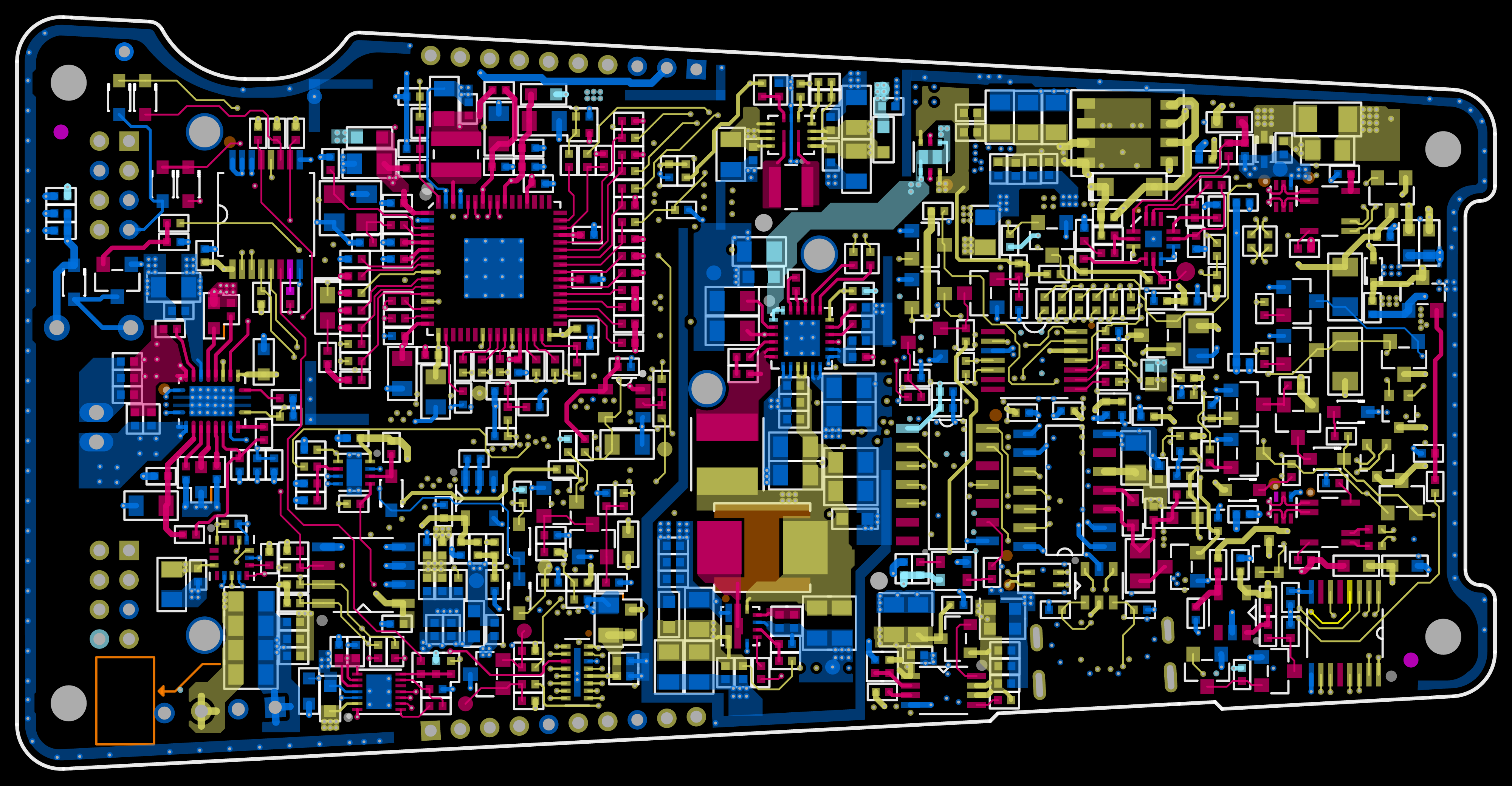
- PCB Design — Multi-layer PCB design (4-layer main board, 2-layer sub-board) with high-density component placement
- Firmware Development — Embedded Linux (device drivers, BSP, power management, OBD protocol stack, cloud connectivity)
- Mechanical Design — ABS enclosure with IP65 sealing, OBDII connector integration, wireless charging receiver alignment
- Prototype Manufacturing — PCB assembly, bring-up, and functional verification of early engineering samples
- DVT (Design Verification Testing) — Full environmental, electrical, and functional validation including drop tests, temperature cycling, OBD plug/unplug endurance
- Compliance Certifications — FCC Part 15, RoHS, California Proposition 65 (CP65), SAR
- PVT (Production Validation Testing) — Production line setup, diagnostic fixture design, yield optimization
- Mass Production & Shipping — Manufactured thousands of units; packaged in custom carton boxes with UL-certified power adapters and accessories; shipped directly to the USA
Engineering Challenges
Compact, Rugged Form Factor
Packaging a multi-radio platform (LTE, Wi-Fi, BLE, GPS, OBD), battery, LCD, and full wireless charging coil into a 130 × 60 × 30 mm IP65-rated handheld enclosure
Multi-Antenna RF Performance
Fitting LTE, Wi-Fi/BLE, and GPS antennas within a small metal-free plastic enclosure without inter-antenna interference or de-sensitization
OBD Protocol Auto-Detection
Ensuring compatibility with all vehicle OEMs by auto-detecting and switching among CAN, ISO 15765-4, SAE J1850 VPW (GM), and SAE J1850 PWM (Ford) protocols dynamically using relay-switched hardware
Automotive Voltage Transients
Protecting all electronics from vehicle OBD port voltage spikes, load dumps, and reverse polarity events typical of automotive environments
Battery Safety & Longevity
Implementing multi-layer Li-Po battery protection (overcharge, over-discharge, over-current, short circuit) for a device that may be dropped, stored in a hot car (Phoenix summer) or a cold trunk (Detroit winter)
Thermal Management
Ensuring safe operation when the device is left plugged into a vehicle's OBD port in extreme temperatures (−20°C to +70°C ambient)
Mechanical Durability
Designed to survive the harsh reality of a workshop environment: dropped onto concrete, tossed into a toolbox, and subjected to thousands of OBD plug-in/plug-out cycles
Always-On Cloud Connectivity
Keeping the device in a low-power but cloud-ready state so vehicle data is available on the cloud platform the instant the device is inserted into the OBD port
GPS Time-to-First-Fix & Accuracy
Optimizing GPS antenna placement and AGPS configuration to achieve fast location lock inside a service lane environment with partial sky visibility
Multiple Compliance Certifications
Achieving FCC Part 15, SAR, RoHS, and CP65 certification simultaneously within a tight development schedule, with parallel LTE module carrier approval
Major Hardware Components
STM32MP157C
Main application processor: dual-core ARM Cortex-A7 @ 650 MHz + Cortex-M4 co-processor (STMicroelectronics)
512 MB DDR3 RAM
System memory for Linux OS and application runtime
4 GB eMMC Flash
Storage for OS image, firmware, logs, and configuration
STN2120
OBD Translator IC: supports all standard OBD-II protocols with automatic protocol detection and relay-switched hardware interface
MCP2518FD
CAN FD Controller: high-speed CAN FD (up to 8 Mbps) for modern vehicle diagnostics
AP6256
Wi-Fi 5 (802.11ac) + Bluetooth 5.0 combo module (2.4/5 GHz)
LTE Module
4G LTE modem for cloud connectivity in areas outside dealership Wi-Fi coverage
MAX17201
Fuel Gauge IC: coulomb-counting battery state-of-charge monitoring
BQ24195
Battery Charger IC: multi-source input (USB / OBD port), supports 5V@2A USB-C charging
BQ51050B
Wireless Charging Receiver IC: Qi-compatible inductive charging receiver
RTL8211EG
Ethernet PHY (100/1000BASE-T) for wired LAN interface
MAX16126, ISL6146, ECLAMP2410, PJE5V0U8
Protection ICs: automotive transient protection, reverse polarity, and ESD clamping
Major Interfaces & Protocols
OBD-II (SAE J1962)
Primary vehicle interface connector; supports all standard OBD-II protocol variants
ISO 15765-4 (CAN)
Standard CAN-based OBD protocol for modern vehicles
SAE J1850 VPW
Variable Pulse Width Modulation protocol used in GM vehicles
SAE J1850 PWM
Pulse Width Modulation protocol used in Ford vehicles
CAN FD
High-speed CAN Flexible Data Rate for next-generation vehicle diagnostics via MCP2518FD
LTE (4G)
Cloud connectivity via embedded LTE modem; FCC-certified bands including Band 255 and Band 46
Wi-Fi 802.11a/b/g/n/ac
Dealership Wi-Fi connectivity via AP6256 module (2.4 GHz & 5 GHz dual-band)
Bluetooth 5.0 BLE
Pairing with the client mobile app for provisioning, status display, and local data transfer
GPS/GNSS
Location tracking for vehicle movement detection and telematics
USB Type-C
Firmware update, diagnostics, and battery charging (5V @ 2A)
Qi Wireless Charging
Inductive charging via BQ51050B receiver; compatible with standard Qi charging pads
LCD Display
Status display: shows device state, username, brand logo, and key parameters
I²C, SPI, UART, GPIO
Internal inter-IC communication buses for sensor, display, and peripheral control
Key Firmware & Software Activities
BSP & Linux Kernel Bringup
Board Support Package for STM32MP157C including U-Boot bootloader, kernel configuration, and device tree customization
OBD Protocol Stack
Implementation of multi-protocol OBD-II communication layer with auto-detection and relay switching logic via STN2120
LTE Modem Driver & Connectivity Manager
AT command interface, PPP/MBIM data connection management, automatic reconnect, and cloud keep-alive
Wi-Fi & BLE Driver Integration
AP6256 module integration for dual-band Wi-Fi and BLE 5.0; BLE GATT service for mobile app pairing and provisioning
GPS Driver & Location Services
NMEA parsing, AGPS support for fast time-to-first-fix, vehicle motion detection using OBD speed + GPS cross-validation
Power Management Subsystem
Active/Sleep/Deep-Sleep state machine; 2-minute idle sleep timer (cloud-configurable); wake-on-OBD-plug, wake-on-charger, wake-on-button
Battery Management
Fuel gauge integration (MAX17201), charger control (BQ24195), over-temperature and safety cut-off logic
Wireless Charging Integration
BQ51050B status monitoring, charge state reporting to LCD and cloud
Production Diagnostic Firmware
Factory test firmware for automated functional testing on the production line (RF, OBD interface, LCD, battery, GPS)
OTA Firmware Update
Secure over-the-air firmware update mechanism via the client's cloud platform for field-deployed devices
Technical Specifications
Summary
The OBD-II Diagnostics Device is a testament to Qmax Systems' capability to deliver a complex, multi-technology IoT product — from concept to mass production — for a demanding North American automotive market customer. The project required deep expertise across hardware architecture, embedded Linux firmware, multi-protocol OBD-II vehicle communication, RF/antenna engineering, automotive-grade protection design, and compliance certification.
By maintaining always-on cloud connectivity, auto-detecting vehicle protocols, and delivering data to the client's cloud platform the moment the device is plugged into a vehicle, the OBD-II Diagnostics Device transformed the dealership service lane experience — enabling service advisors to greet customers by name, pull vehicle history instantly, and create repair orders automatically. The device continues to be deployed across the client's growing dealership network across North America.
This engagement demonstrates Qmax Systems' ability to serve as a complete product development partner — handling every phase from industrial design and hardware through compliance certification, production diagnostics, mass manufacturing, and direct international shipment — making Qmax a trusted full-stack R&D and manufacturing partner for IoT and connected device companies worldwide.