Rugged Android Digital Signage Player
Project Overview
A major US-based retail technology company approached Qmax Systems to design and manufacture a ruggedized Android Digital Signage Player for deployment across auto showrooms throughout North America. The product needed to simultaneously display live TV channels via HDMI input and overlay dynamic digital signage content — promotions, notifications, and scheduling — in a picture-in-picture configuration.
Qmax Systems delivered the complete product from concept to volume production: hardware design, firmware and Android software development, industrial design, FCC certification, and fulfillment — packaging thousands of units and shipping them directly to the customer's US distribution point. The product has been running in the field for nearly four years with near-zero reported failures.
Product Brief
The Rugged Android Digital Signage Player is a fanless, wall-mountable media appliance powered by the Rockchip RK3566 quad-core SoC running Android. It accepts a live HDMI video source (e.g. a cable set-top box or satellite receiver) and renders it alongside managed digital signage content, delivering a unified display experience on any 4K HDMI-connected commercial display.
The unit is housed in a custom CNC-machined aluminum enclosure rated IP54 for commercial environments. It ships with a UL-certified US power adapter, HDMI cable with ferrite cores, and a custom IR remote control — all packed in a branded retail-style carton box, ready for end-user installation. Power-over-Ethernet (PoE) is supported for cable-reduced installations, and over-the-air (OTA) content and firmware updates are fully operational.
Qmax Scope of Work
Qmax Systems executed the entire product lifecycle under one roof, from the first architectural sketch to palletized shipments bound for North America:
- Full hardware architecture, schematic design, and BOM development for the RK3566-based mainboard
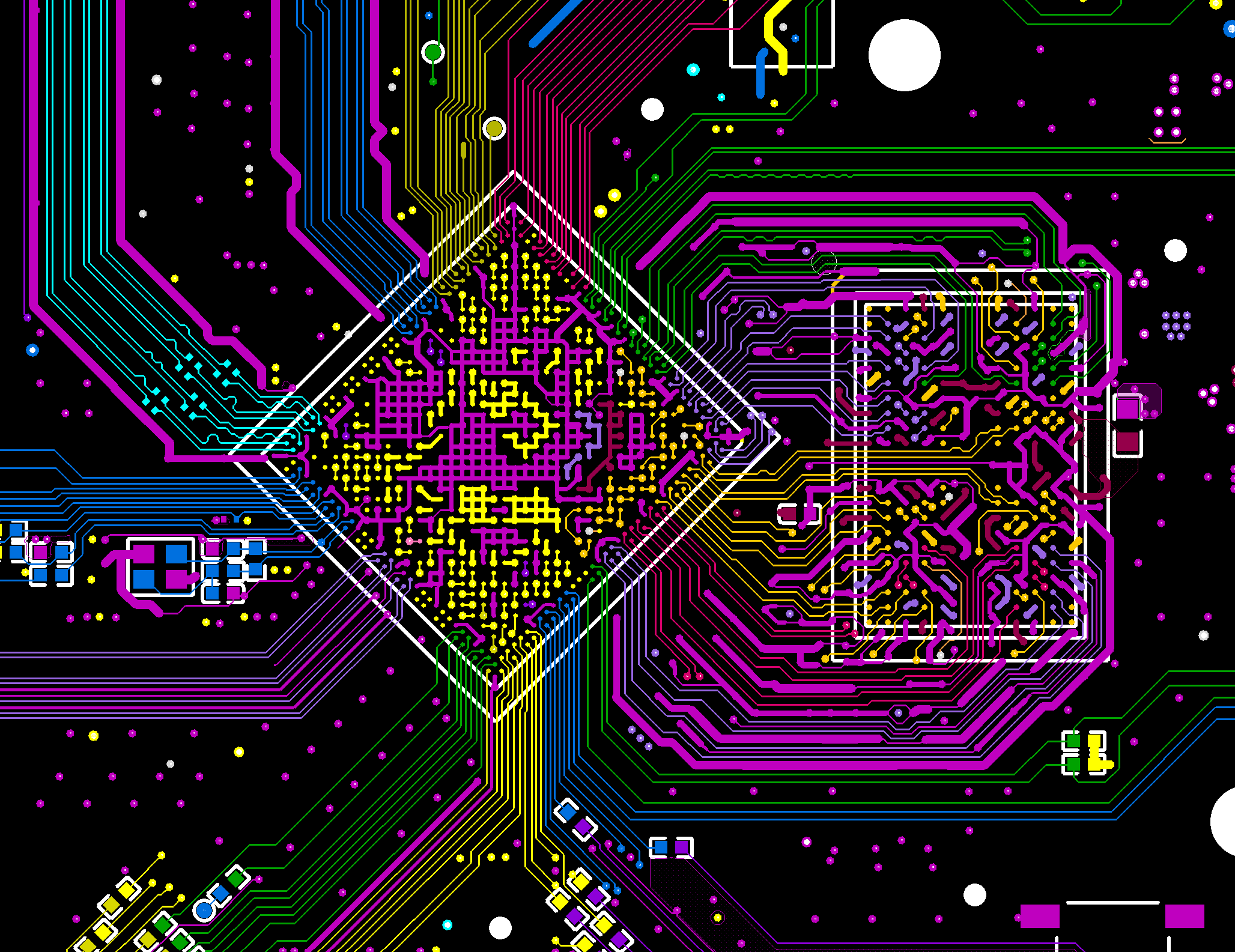
- 6-layer HDI PCB design including high-speed LPDDR4, HDMI 2.0, and USB 3.0 routing with controlled impedance
- Prototype builds, bring-up, and design iterations through DVT (Design Validation Testing) and PVT (Production Validation Testing)
- Low-level Linux kernel driver development: LT6911 V4L2 HDMI-to-CSI driver, Android Camera HAL adaptation, I2S audio pipeline, IR remote driver, and status LCD driver
- Full Android BSP bring-up including kernel configuration, device tree authoring, and PMIC bring-up on RK3566
- Android application development: HDMI live input viewer, picture-in-picture signage engine, content scheduler, IR remote control integration, and OTA update client
- HDCP license acquisition and provisioning into the LT6911 firmware for compliant display of protected TV content
- Industrial and mechanical design of the CNC-machined aluminum fanless enclosure with IP54 rating and integrated thermal management
- FCC Part 15 certification management including EMI/EMC troubleshooting, filter design, and re-test coordination
- Full production manufacturing, test jig development, accessory sourcing (UL power adapter, HDMI cables with ferrite, custom remote), carton packaging, and direct shipment to the customer's US warehouse
Engineering Challenges
HDMI input on Android SoC
No commercial RK3566-class SoC provides a native HDMI RX interface; a creative bridge architecture using the Lontium LT6911 HDMI-to-MIPI CSI-2 converter was designed and kernel-driver developed from scratch
Lip sync between HDMI input audio and video
The RK3566 audio and video pipelines run on independent clock domains; extensive driver-level tuning of PTS timestamps across the V4L2 and ALSA subsystems was required to achieve compliant A/V synchronisation
FCC Part 15 first-attempt failure
Radiated emissions exceeded limits on HDMI lines; resolved by adding EMI filter arrays on HDMI signal lines and specifying HDMI cables with ferrite clamp cores
Fanless thermal management
The RK3566 under full 4K decode and WiFi load generates significant heat; the aluminum enclosure was engineered as a heatsink with direct thermal interface material paths, enabling sustained operation without active cooling
Dense 6-layer PCB layout
Routing LPDDR4 (64-bit bus), HDMI 2.0 differential pairs, USB 3.0 SuperSpeed, and GbE on a compact board required meticulous impedance control, layer stack-up planning, and via-in-pad techniques
HDCP key provisioning at scale
Each unit requires unique HDCP keys programmed into SPI flash at production; a custom factory fixture, automated provisioning script, and traceability database were developed to handle volume production reliably
Major Hardware Components
Rockchip RK3566
Quad-core ARM Cortex-A55 SoC at 1.8 GHz with Mali-G52 GPU, 1 TOPS NPU, 4K H.264/H.265 hardware decode, HDMI 2.0a output, and MIPI CSI-2 RX interface
RK809-5 PMIC
Multi-channel power management IC providing all core, DDR, IO, and peripheral voltage rails for the RK3566 with programmable DVFS for thermal regulation
Lontium LT6911UXC
HDMI 2.0 to MIPI CSI-2 bridge IC; converts incoming 1080p60 HDMI signal to 4-lane CSI-2 YUV422 stream with embedded I2S audio output and HDCP 2.2/1.4 RX support
LPDDR4 SDRAM
High-speed 64-bit wide memory providing the bandwidth required for simultaneous 4K decode, CSI-2 DMA capture, and Android workloads
eMMC 5.1 Flash
Embedded storage in HS400 mode for Android OS, applications, and local signage content with A/B partition layout for OTA updates
Gigabit Ethernet PHY
RGMII-interface PHY (Realtek RTL8211F) supporting 10/100/1000 Mbps with EEE and MDI/MDIX auto-negotiation
24 W PoE Module
IEEE 802.3af/at compliant PD controller with integrated DC-DC conversion, providing up to 24 W from a standard PoE switch to power the complete unit
WiFi 6 + Bluetooth 5 combo module
Dual-band 802.11ax and BT 5.x module connected via PCIe and UART, with U.FL antenna connectors for external antennas
SPI NOR flash (W25Q16)
Dedicated 16 Mbit flash for LT6911 firmware and HDCP key storage, programmed at factory with Lontium-provided firmware
CNC-machined aluminum enclosure
IP54-rated fanless enclosure precision machined from 6061 aluminum alloy, acting as both mechanical chassis and primary heatsink with thermal interface material pads
Custom IR remote control
38 kHz NEC-protocol remote with custom keylayout; keymapped to signage application functions and branded for the end customer
Status LCD / OLED display
Small front-panel display connected via SPI/I2C showing IP address, PoE power state, HDMI input lock, content schedule state, and fault codes
Major Interfaces & Protocols
HDMI Input (HDCP 2.2)
1080p60 HDMI 2.0 source input via LT6911 bridge; supports HDCP 1.4 and 2.2 protected content from set-top boxes and satellite receivers
HDMI Output (4K @ 60 Hz)
Native HDMI 2.0a output from RK3566 driving 4K commercial displays; supports 4K30 and 1080p60 with HDR metadata pass-through
Gigabit Ethernet with PoE
IEEE 802.3af/at PoE PD on the RJ45 port; supports 10/100/1000 Mbps for content delivery, OTA updates, and CMS connectivity
WiFi
Dual-band 802.11 a/b/g/n/ac/ax (2.4 GHz + 5 GHz) for wireless content and management connectivity in environments where Ethernet cabling is impractical
Bluetooth 5.x
BLE and Classic Bluetooth for proximity sensors, BLE beacons, and wireless peripheral pairing
USB 3.0
SuperSpeed USB Type-A host port for external storage, capture cards, or USB-connected accessories
USB 2.0
Two Type-A USB 2.0 host ports for keyboards, mice, USB hubs, and provisioning during manufacture and deployment
IR Remote Interface
38 kHz IR receiver with rc-core driver supporting NEC and RC5 protocols; custom remote control programmed to the signage application keylayout
Status LCD
Small SPI/I2C connected OLED/LCD display on the unit face showing IP address, PoE status, HDMI signal state, content schedule status, and error codes
I2C / SPI / RTC / GPIO
Internal interfaces for PMIC, LT6911 control, RTC (real-time clock for scheduling), status LCD, and board management functions
Key Firmware & Software Activities
BSP & kernel bring-up
RK3566 Android 12 SDK configured for custom board; full device tree written covering MIPI CSI-2, I2S RX, IR, SPI LCD, GbE PHY, PoE GPIO, and USB3. PMIC sequencing and DVFS tuning validated.
LT6911 HDMI-to-CSI driver development
Full V4L2 subdev kernel driver written for RK3566 rkcif stack: probe, hot-plug interrupt handling, DV timings negotiation, and dynamic resolution change support. LT6911 firmware sourced from Lontium and provisioned via SPI flash at factory.
HDCP key provisioning & license management
HDCP 1.4 and 2.2 RX keys provisioned into each unit's LT6911 SPI flash during production. Custom factory fixture and traceability log developed for compliance.
Android Camera HAL3 & zero-copy display pipeline
Camera HAL3 adapted to expose LT6911 CSI-2 stream as an Android camera device. Zero-copy display path built: CSI-2 DMA → rkcif → DRM/KMS overlay plane → HDMI TX, bypassing GPU compositing for minimal latency passthrough.
Audio pipeline & lip sync tuning
I2S RX brought up with LT6911 as I2S master. ASoC machine driver and Android Audio HAL written. PTS timestamp correlation between V4L2 video capture and ALSA I2S audio implemented; compensating frame queue applied to achieve HDMI-spec lip sync tolerance (±15/45 ms).
IR remote driver & keylayout
rc-core NEC/RC5 driver enabled and Android .kl keylayout file written for custom remote control. Keys mapped to signage app functions: source select, volume, PiP toggle, content navigation, and menu.
Signage application & PiP engine
Android application built for dual-source picture-in-picture: live HDMI input rendered via SurfaceView with Camera2 API; signage overlay rendered via a second SurfaceView with hardware-accelerated compositing. Content scheduler, OTA update client, and CMS integration included.
OTA update infrastructure
A/B partition OTA update mechanism implemented using Android's RecoverySystem API. Signage content and application updates delivered over Ethernet or WiFi, with rollback on failure and remote reboot capability.
Technical Specifications
Summary
The Rugged Android Digital Signage Player demonstrates Qmax Systems' end-to-end product development capability — from an unconventional architectural challenge (HDMI input on a SoC with no native HDMI RX) through to volume-manufactured units running in commercial environments across North America. The project required deep expertise across hardware design, kernel and BSP development, Android application engineering, regulatory certification, and manufacturing operations simultaneously.
With thousands of units deployed and near-zero field failures over four years of continuous operation, the product stands as a flagship reference for Qmax's concept-to-production methodology. The same full-stack capability — architecture, PCB design, firmware, Android, industrial design, certification, and manufacturing — is available to customers bringing new product ideas to market.